
As a webshop, you want every customer to be able to search, compare, order, pay and return products independently. Yet in practice, that is far from a given.
Recent research by the Netherlands Authority for Consumers and Markets (ACM) shows that 61 percent of the largest Dutch webshops are not digitally accessible. As a result, many people with a disability cannot shop online, or cannot do so properly.
Since 28 June 2025, the European Accessibility Act has also applied to relevant e-commerce services.
For webshops, digital accessibility is therefore not a paper obligation, but a direct combination of compliance, inclusion and revenue.
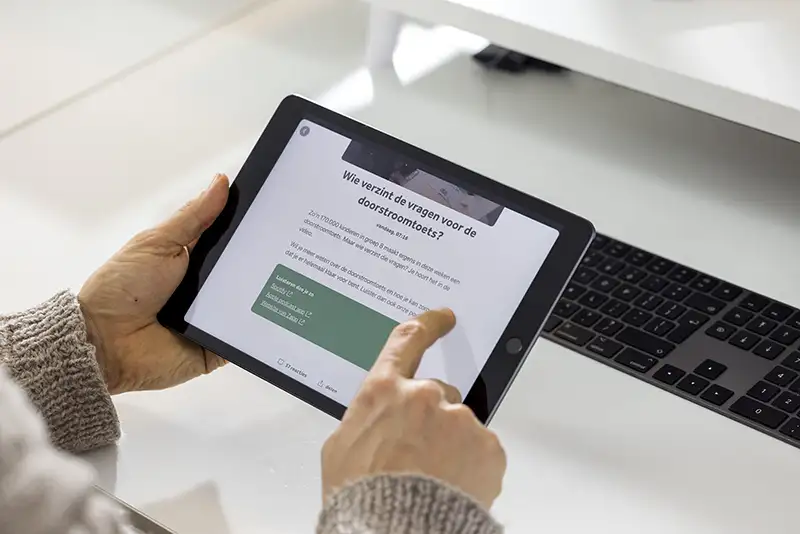
Webshops get started with digital accessibility for different reasons. For some, legislation is the direct trigger; for others, customer focus, inclusion or conversion improvement plays the main role.
In practice, these reasons reinforce each other: an accessible webshop helps you limit risks, reach more customers and improve the online shopping experience for everyone.
Since the European Accessibility Act, digital accessibility is no longer optional for many webshops. If you sell to consumers and meet the conditions, your webshop is likely to fall under these rules.
Digital accessibility is also about being able to participate on an equal basis. An inaccessible webshop excludes customers who use assistive technology. By taking this into account, you ensure that everyone can use your webshop.
You are not only told what goes wrong, but also how it can be improved. With clear examples, practical explanations and support during implementation, we help you actually improve accessibility in your webshop.
Digital accessibility is more than an accessibility audit alone. That is why Audit House offers several programmes to embed digital accessibility within the organisation. The flow below is the most complete, but we take a tailored approach with every webshop. This ensures our expertise fits your organisation.
We start with an audit to determine how accessible the webshop currently is. We look not only at individual pages, but specifically at the parts that are commercially and functionally critical. This makes clear where customers drop out and where the biggest opportunities for improvement lie.
For webshops, responsibility usually does not stop at the website alone. Email campaigns, social posts, landing pages, forms and other digital communications also play a role in the overall customer journey. That is why we can additionally analyse the accessibility risks there.
After the audit, we discuss the findings with your team, looking at both technology and content. We prioritise what needs to be fixed first, so you can improve in a targeted way. If you work with an external web developer or platform supplier, we are happy to involve them in the review.
Embedding accessibility only works if teams know what to look out for. That is why we provide training, if desired, for employees who create content or develop. Think of training for editors, marketers, UX/UI designers and developers, so that new problems are prevented and accessibility becomes part of the process.
If you want to communicate transparently about the current status and next steps, we also help you draw up an accessibility statement. This lets you clearly explain what is already in order, what is still being improved and the related planning.
A retest is an optional step after improvements have been implemented. It allows us to check whether the accessibility problems found earlier have actually been resolved and how much more accessible the webshop has become. That is not only valuable for your own team, but also reassuring for customers and other stakeholders: it shows that accessibility is taken seriously and that demonstrable work has been done towards a better, more inclusive webshop.
You will not get a report from us that disappears to the bottom of the backlog. You get a practical accessibility audit with concrete improvements for developers, marketers, content teams and external suppliers.
This makes accessibility workable in the day-to-day practice of e-commerce. Audit House audits are based on WCAG 2.2 level AA and are carried out according to the WCAG-EM methodology.
You want to know quickly where you stand. That is why we usually deliver the results of an audit within one month, so you can quickly take action with your team or supplier.
Our findings are not only readable for people, but also usable in processes. Easily export the reports to HTML, JSON, CSV and PDF. This makes it easier to process issues in your own project management or ticketing system.
You are not only told what goes wrong, but also how it can be improved. With clear examples, practical explanations and support during implementation, we help you actually improve accessibility in your webshop.
That depends on what you offer and how large your organisation is. The EAA is often relevant for e-commerce. Micro-enterprises may be exempt under certain conditions. An initial check of the scope and exemptions is therefore advisable.
No. As with other WCAG-EM audits, we work with a representative sample of page types, components and important user flows. For webshops, this means extra attention to crucial processes such as searching, filtering, checking out and returning products. This gives us a representative picture of the webshop, without having to check hundreds or thousands of pages.
Yes. Especially with webshops, it is important that technical findings reach the party that has to build the solution. That is why we also discuss findings together with external suppliers.
In addition, the findings from the report can easily be loaded into their project management software, such as Jira, via a CSV export.
Yes. We help you draw up an accessibility statement that fits your webshop, the outcomes of the audit and the steps that are still needed.
This makes clear which parts are already accessible, where improvements are still needed and how you are working towards them.
This not only supports transparent communication with customers and regulators, but also helps you demonstrably work in line with the requirements of the EAA legislation.
Digital accessibility only stays at the right level if it becomes part of the organisation and does not depend on a one-off audit. That is why Audit House also offers training for employees who create, design or develop content.
Think of training in digitally accessible content, accessible development and awareness within teams.
This teaches employees what to look out for in their daily work, so that new accessibility problems are prevented and accessibility is structurally embedded within the organisation.






From Audit House, you receive not only a report with the current issues on your webshop – we also think along with you to make your website more accessible.
We discuss the current issues, go through possible solutions and help with concrete code examples of accessible elements.